
9 Luberon Ruins with Killer Views (Year-Round Free Access)
For some ancient sites with great views, add Luberon ruins to your itinerary. You learn a bit of history, work out your butt, and enjoy the scenery.
Open all year long, these sites are ideal for off-season travelers or those seeking free things to do in the Luberon.
Unlike museums and attractions that might be closed from November-February, these historical spots are not bound by opening or closing hours. You can visit them anytime, even in winter.
In this article, I’d like to focus on vantage points in less-known villages, which means I won’t be tackling popular viewpoints in Gordes, Ménerbes, and Roussillon.
By the way, if you’re new to my travel blog, hello!
I’m Jenny and I spend a lot of time viewpoint-hunting and ruins-hopping in the Luberon, my home. I have visited all the sites on this list, and I’d love to share them with you. Below are my top picks. Enjoy!
Map of Luberon Ruins with Viewpoints

1. BONNIEUX: Pont Julien
A Roman Bridge Still Standing
(sounds like bon-yew and pong jewl-ya)
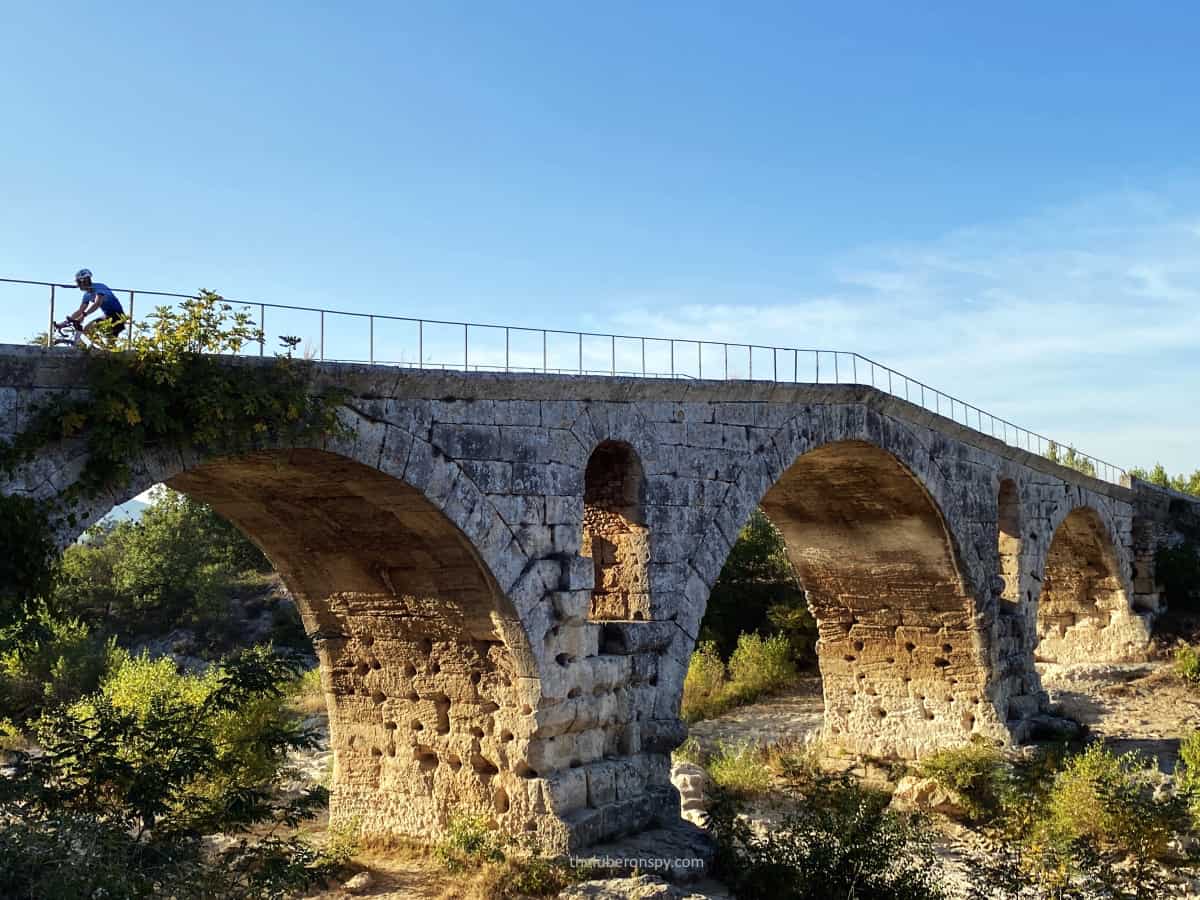
Did you know there’s a 2000-plus-year-old bridge in Bonnieux?
Le Pont Julien (or The Julien Bridge) is a three-arch stone bridge built in 3 BC over the Calavon river. It was an important part of the Via Domitia, the Roman road linking Italy to Spain via conquered Gaul (which ancient France was a part of).
Named after Julius Caesar’s Apta Julia (today’s town of Apt), the bridge served as a way to transport troops and resources. Since the Gallo-Roman period, this place had been popular for walks where travelers stopped in a nearby tavern.
Size and Material
Pont Julien, made of locally-sourced limestone blocks (called molasse), is cleverly built with minimal binders. It is 85 meters long, 5.5 meters wide, and 11.5 meters high (278 x 18 x 37.7 feet).
That’s roughly three-fourths the length of a football field and as tall as two stacked giraffes.
This bridge, over 2000 years old, supported car traffic until 2005 and got an iron railing in 1950. In 1914, it received protected status as a Monument Historique in France.
Today, it’s a pretty walkway for pedestrians and cyclists (but no horses), along the Veloroute du Calavon, a green, family-friendly cycling path.
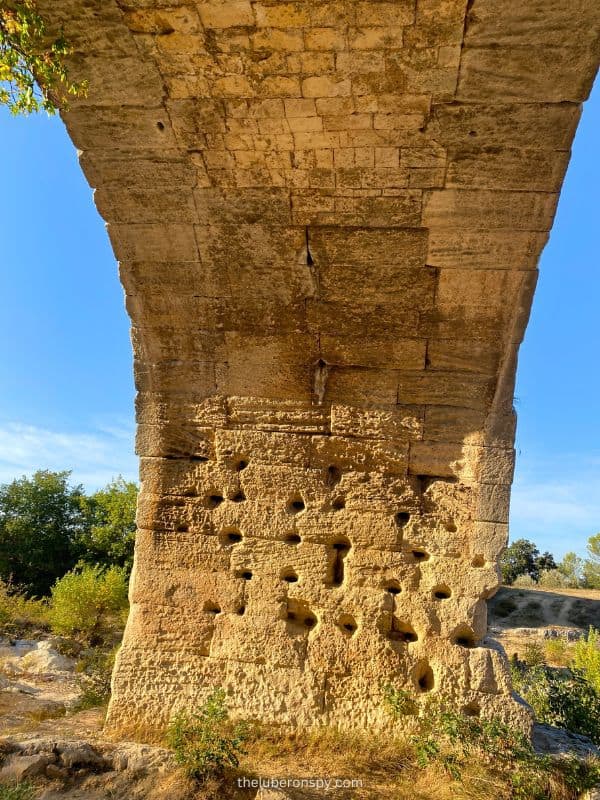
Fun fact: During my research, I stumbled upon an interesting bit: Signs of habitation were found in an arched opening on the left side of the bridge. A historian speculates it might have been a hermit’s dwelling. Could this be true?

How to Visit Pont Julien
Pont Julien is between Bonnieux and Roussillon. It’s a few hundred meters from the main D900 road (formerly the N100 imperial road).
You can’t miss the free parking area near the bridge, accommodating around 15 cars, with some spots under the shade of trees.
When I visit the Roussillon market on Thursdays, a stop at Pont Julien on the way back is a treat. It’s fun to wander in the lush surroundings. Plus, with the river mostly dry, you can walk under the bridge and touch the riverbed’s large, white, marble-like rocks.
Suggested duration of visit: 30 minutes
2. BUOUX: Fort de Buoux
Epic 360° Views but not for Children (or the Faint of Heart)
(sounds like byoox)
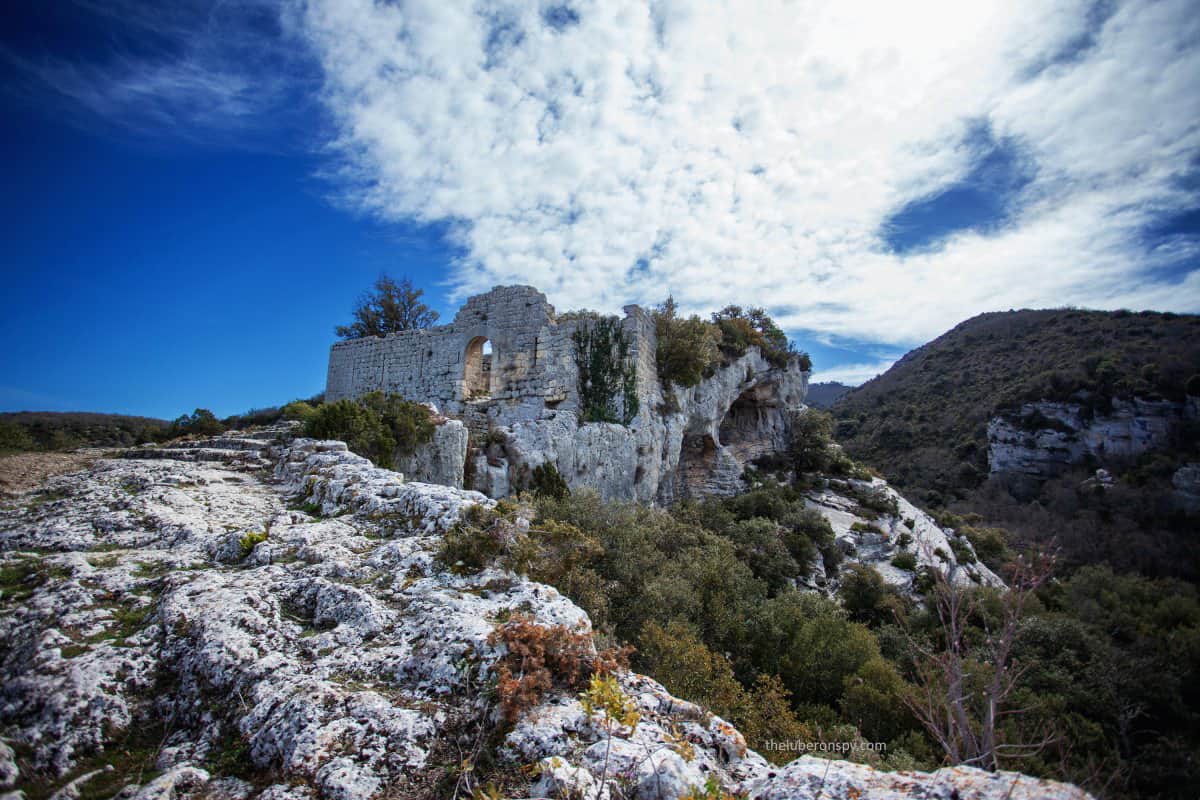
Fort de Buoux is a must-visit for anyone who loves history and archaeology, with a lick of…danger?
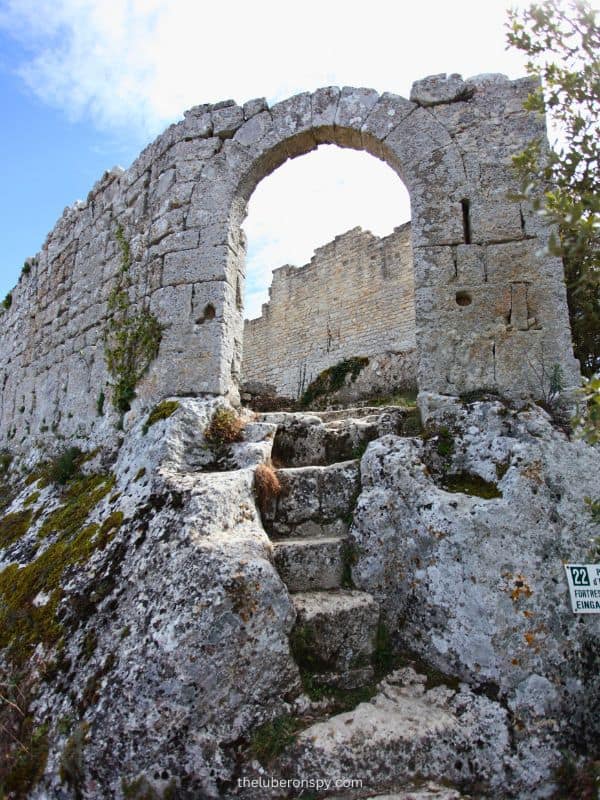
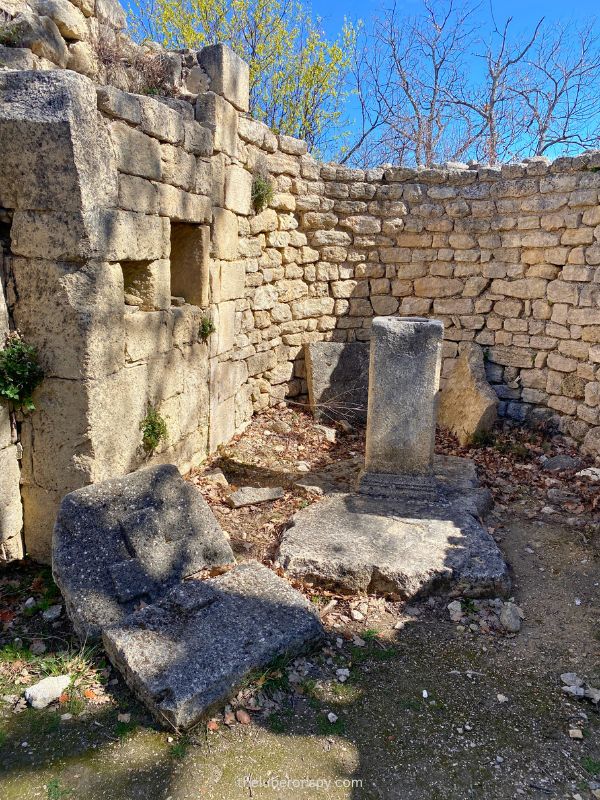
The ruins, spanning from protohistory to the 17th century, include an ancient village, a 13th-century church, rock-cut silos, and troglodyte dwellings. There’s also a three-story square tower, with a side door that experts claim could only have been accessed by a flying bridge.
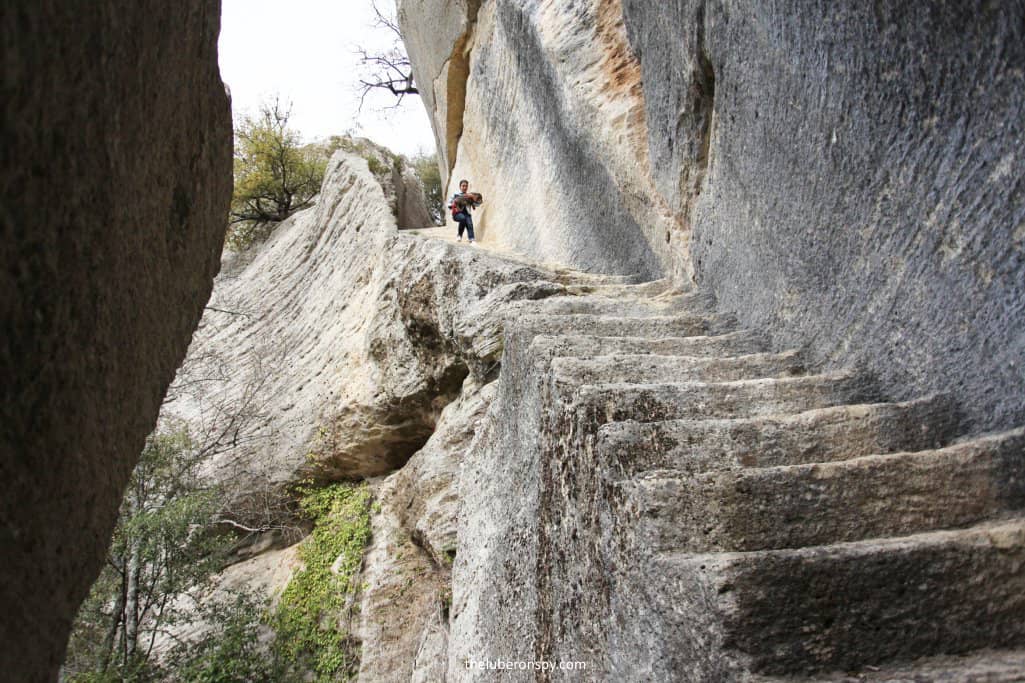
When I visit Fort de Buoux, the highlight for me is always the secret staircase: 60 cliff-carved steps leading mysteriously to the valley, speculated to be anything from an escape route to a sacred path.
Be careful. The steps are uneven and steep with no guard rails. If you are scared of heights, are pregnant, or have little kids, do NOT use the stairs. Go back to the entrance.
My husband has mild vertigo, so I had to carry our nervous 26-pound dog down the steps. When I reached the platform, I was sweating and so relieved it was over. At least I have this for posterity:
Fun fact: Did you know Buoux was a global rock climbing hot spot in the 1980s? Dubbed “The Laboratory,” daredevils came here to test their wild, never-done-before routes.
From Fort de Buoux, you can see the Aiguebrun valley below and the legendary crags that put this place on the map.
By the way, don’t confuse Fort de Buoux with Château de Buoux. The latter is only open to students on educational trips, though big renovations are underway to welcome the greater public in 2026.
SAFETY REMINDERS
- Visiting the fort built on a rocky outcrop is dangerous.
- There are no guard rails or fences. Do not approach the edge of cliffs or throw stones below.
- Children of all ages are allowed, but I do NOT recommend bringing small kids.
- Dogs are also allowed but must be on leash. I do not recommend bringing pets.
- If you have vertigo, return to the entrance. Do NOT use the secret staircase to exit.
- Avoid in bad weather.

How to Visit Fort de Buoux
This former oppidum is the only place on this list that has an entry fee (only 6€). I find it fascinating; it’d be crazy not to include it.
Use your car’s GPS or follow the signs to the fort’s parking area. From there, enjoy a mildly uphill 10-minute walk to the entrance. You will see impressive boulders, overhanging cliffs, and sarcophagi tombs.
At the entrance, you’ll find a gate and picnic tables. Buy your tickets at the office, where a friendly, French-speaking old man welcomes visitors.
You’ll receive a simple A4 paper guide, available in French and English (possibly other languages, too). It has a basic map of the fort with numbered labels. Information is very limited, so it’s best to read up on the site beforehand.
Don’t expect a well-preserved site with information panels and QR codes for historical details. Most structures are in ruins which, in my opinion, only enhances the marvel and ambiance of the place.
Do note there’s not much shade at the ruins. If you’re visiting in the summer, avoid when the sun is intense. (I don’t get why they don’t open before 10am.)
I do not recommend Fort de Buoux for small children, pregnant women, or those with mobility issues. For everyone else, the terrain is fairly accessible, and hiking sticks aren’t necessary.
Suggested duration of visit: 1.5-2 hours including walk from the parking area
Access Details
Opening times: 10am to 5pm (last entry 4:30pm)
Closures: Closed Mondays, Tuesdays, bad weather, and select days between Christmas and January 2 (check website for exact dates)
Winter season: Mid-November to end-February, call +33 4 90 74 25 75 to confirm opening
Parking: Free
Facilities: Toilets at the entrance; picnic tables, refreshments available in summer
Entrance fees: Adults 6€
Groups of 15, students, young adults (10-25 years): 5€
Children under 10: Free
Payment: Cash or card
3. CADENET: Château de Cadenet
Ancient Hub for River Trade
(sounds like ca-de-ne)
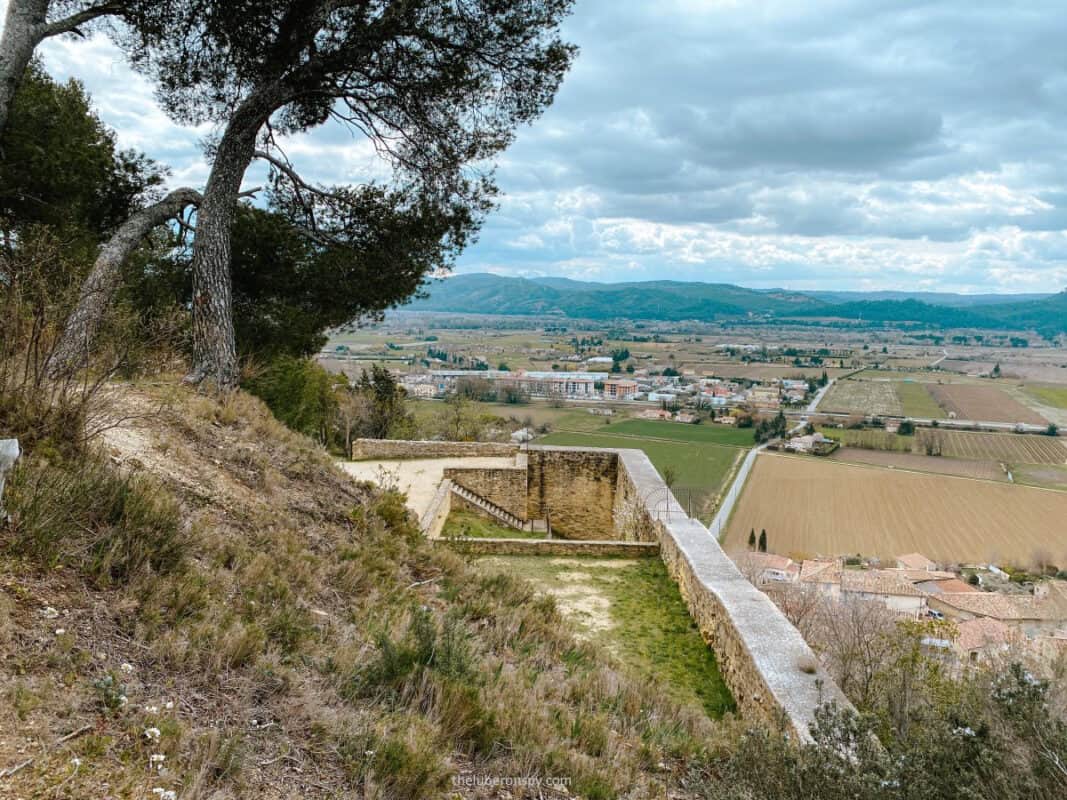
Château de Cadenet was the place to be for trade on the Durance River back in the old days.
Standing atop its plateau, you’re treated to stunning views – the Durance valley, Sainte-Victoire mountain, the Alpilles, northern Luberon, and so many rooftops.
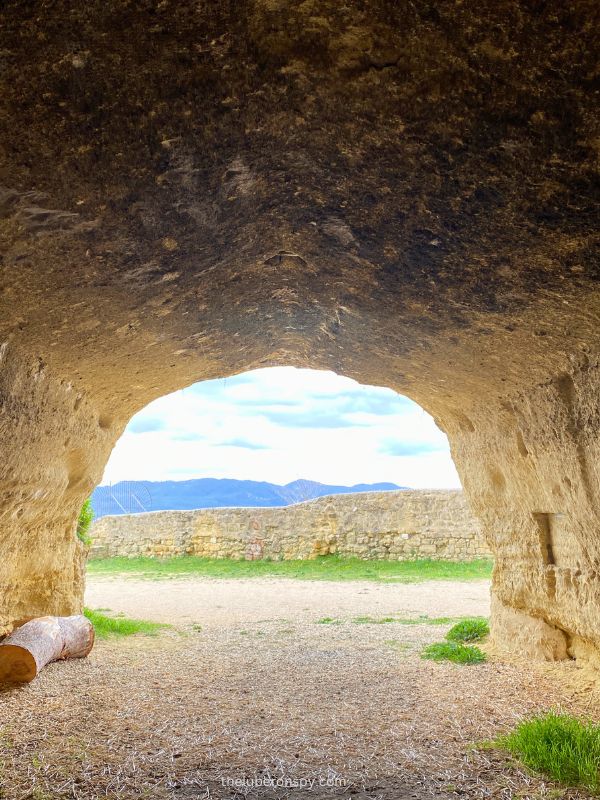
The castle, initially designed as a fortress, suffered assaults and occupations before falling into ruin after the 1792 revolution. Most of its grand 980-meter walls are gone, but you still get a hint of its former glory.
The site is a geologist’s thrill, with 10-million-year-old marine fossils, including huge oysters, embedded in the structures.
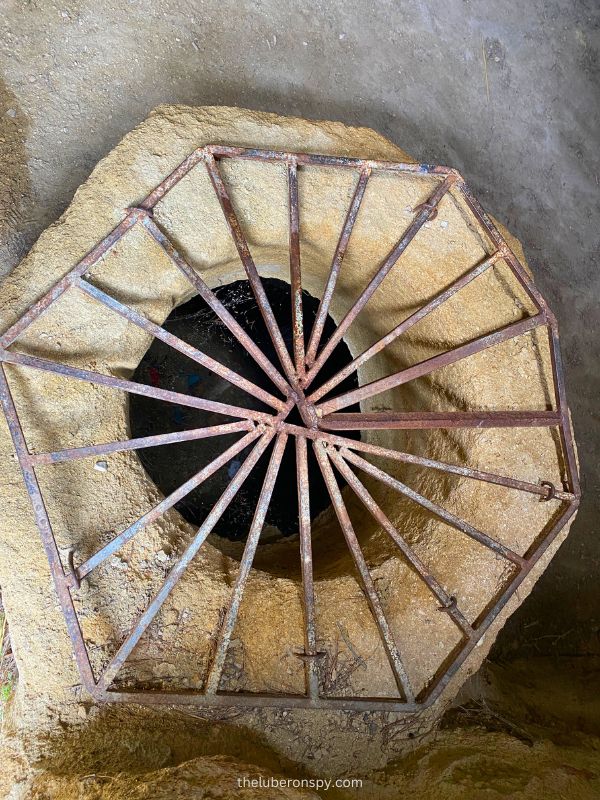
For a bit of spook, try finding the eerie well and looking down – gives me the creeps each time!
A recognized Monument Historique since 1947, the site has been in rehabilitation for a long time.
Fun fact: Each year, the French Heritage Foundation runs a “Loto Patrimoine” to fund endangered monuments. In December 2023, Cadenet château ruins were selected, receiving 130.000€. This funding will help repair the fragile limestone cliffs and safeguard homes below.
How to Visit the Cadenet Ruins
Start your walk from the Place du Tambour d’Arcole. It’s the village center with the Monument to the Drum of Arcole (I call him the “little drummer boy”). It’s an easy 15-minute walk to the ruins.
Fun fact: At just 19, André Estienne from Cadenet, known as the ‘tambour d’Arcole,’ bravely led Napoleon’s troops with his drum in the 1796 Battle of Arcole, helping with their victory.
If you’d like to start closer to the château ruins, there are two parking areas available (type ‘Château de Cadenet parking’ on Google Maps).
The castle grounds are packed with interesting sites, including a belfry, site of former drawbridge, amphitheater, and troglodyte habitats.
Suggested duration of visit: 1 hour, including walk from the village
4. CUCURON: Donjon Saint-Michel
& Tour Sus Pous
Remains of a Triple-Walled Village
(no way to spell the phonetic pronunciation but it sounds like coo-keu-rong)
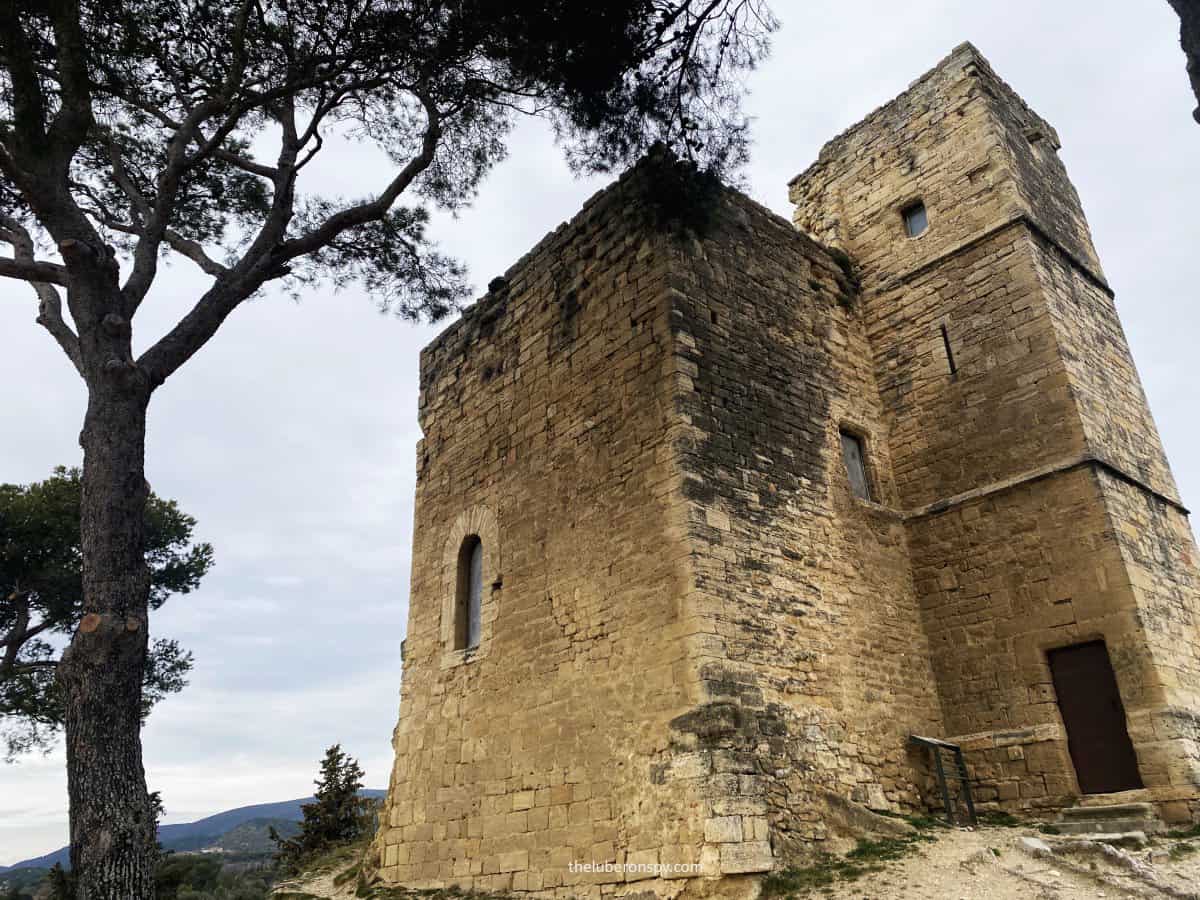
Cucuron is popular for its restaurant-lined pond under centuries-old plane trees. But did you know it has an interesting medieval quarter?
In the 11th century, the first fort (or castrum) sprang up around a castle on the west side of the village. Over time, Cucuron expanded and evolved under a seigneurial system (like feudalism but with a manor and a landowning seigneur at the helm).
During the Middle Ages, Cucuron had three ramparts in concentric circles, like triple-layered defenses.
Today, you can trace Old Cucuron from two small hilltops:
- WEST: Donjon Saint-Michel or Dungeon of Saint-Michel – belonged to the first rampart. This rectangular tower, flanked by a staircase, is a remnant of the 14th century seigneurial castle.
The tower was abandoned in the mid-17th century and deteriorated over time. The local commune later bought it.
Views from up there:
On a nice, clear day, you get nice views of Cucuron and its surroundings: the Luberon range to the north, Vaugines to the west, Cadenet to the southwest, and Ansouis château to the south.
Now, turn your back against the view and face the belfry. You’ll see Tour Sous Pus (Citadel Tower) and the Notre Dame de Beaulieu church in the background. - EAST: Tour Sus Pous or Citadel Tower – from the third line of ramparts, erected on a small hill as part of the village’s fortifications for the 1542 religious wars.
Notice the beam holes in the rock and on the wall, hinting at the houses that once occupied this space. Even cooler, look closely at the tower. Look for an opening, a muzzle slot for a cannon barrel.

How to Visit the Ruins of Cucuron
Cucuron is relatively flat, so it’s easy explore on foot in under one hour. There’s a signposted Circuit du Patrimoine (or Heritage Trail) that starts at the Portail de L’Etang, the stone arch entrance across the village pond.
Simply follow the numbered trail and read historical details at each stop. There are black-and-white photos of old village life. The texts are in French, English, and Provençal.
As you stroll, keep an eye out for picturesque façades, colorful doors and windows, fountains, and stone arches – they’re all part of Cucuron’s charm.
Suggested duration of visit: 1 hour
Local tip: Since you’re already in Cucuron, check out Chapelle de L’Ermitage, a quiet place from almost 500m above. This 1200s chapel, once a pilgrimage sanctuary with hermits until 1791, offers a charming hike.
The panorama at the top is stunning – perfect for enjoying from the benches. Walk from Cucuron’s village pond (2km, 30 minutes) or from Vaugine’s hiking trail (~45 minutes).
While it’s not a ruin, this spot is one of my favorite viewpoints to visit.
5. LACOSTE: Château de Sade
The Home of a Notorious Sadist
(sounds like la-cost)

When I first visited Lacoste, I cringed at the château, knowing a predator of women and children had lived there.
Who has not heard of the infamous Marquis de Sade (real name: Donatien Alphonse François, 1730-1814)? Did you know the word sadism was coined after him?
The 18th-century French writer and philosopher’s erotic literature and real-life sex crimes landed him in jails for 27 years. He died in an asylum in 1814.
Inherited by de Sade from his wealthy family, the château became a den for his wild parties and disgusting crimes. He stayed there from 1769-1772.
Gonzague Saint Bris (1948-2017), award-winning French novelist and Sade biographer, once said: “He made sure that nothing written about sex would surpass him. Fifty Shades of Grey is a nursery book compared to Sade!”
Former owners of Lacoste’s Château de Sade were:
- the Simiane family (11th-16th centuries)
- the Sade family – in 1716, Isabelle Simiane gave it to his cousin Gaspard-François de Sade, Lord of Saumane and Mazan, and grandfather of the marquis
- Marquis of Rovère – a deputy of Vaucluse and Bonnieux resident who bought the ravaged castle after the French Revolution
- Pierre Grégoire – a local farmer who bought the ruins in 1816 “without doors, windows, or chains” for 1200 francs
- Cyprien Jean – a mason in Lacoste
- André Bouer – in 1952, a college teacher who restored the castle until his death
- Pierre Cardin – from 2001 until he died in 2020. Current owner: ?
In 2001, French-Italian fashion icon Pierre Cardin (1922-2020) bought and restored the château, along with a reported 14 buildings in the village.
Today, 22 heirs are fighting over the late designer’s estate, which include the Cardin Group, Maxim’s hotel and restaurant chain, and many properties including Château de Sade.
Cardin transformed Lacoste into a cultural hub, notably through his annual Festival de Lacoste that showcases young artists in dance, arts, and theater.
Lacoste is also home to an overseas campus of the Savannah College of Art and Design (SCAD), further cementing the village’s status as a center of art and creativity.
Fun fact: The Skull (1965) is a British horror film about a collector who gets his hands on the skull of Marquis de Sade and learns it is possessed by an evil spirit.
Interestingly, in reality, a doctor unearthed the notorious writer’s skull for scientific study and even created a plaster cast. Then the original was stolen.
Today, that cast is rumored to be in Paris’s Musée de L’Homme (Museum of Man). The museum seems hush-hush about it, but a Smithsonian article confirms it.
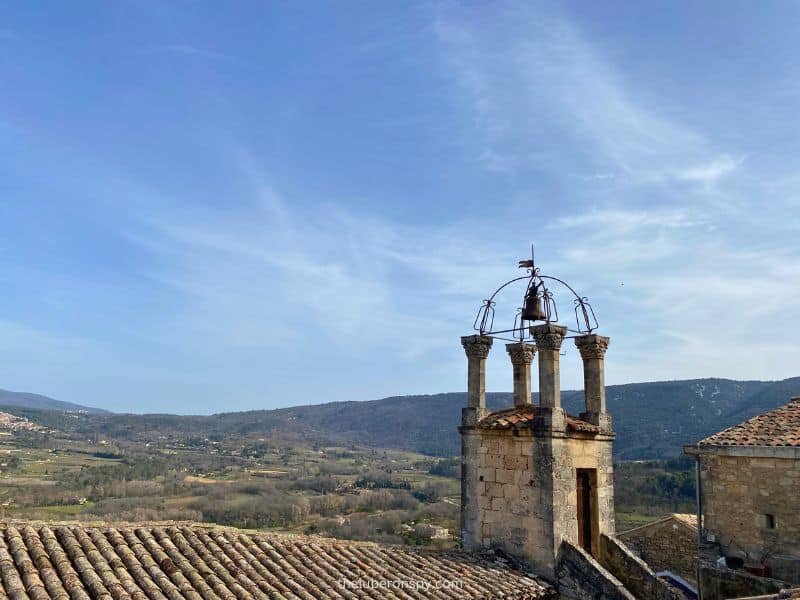
How to Visit Château de Sade
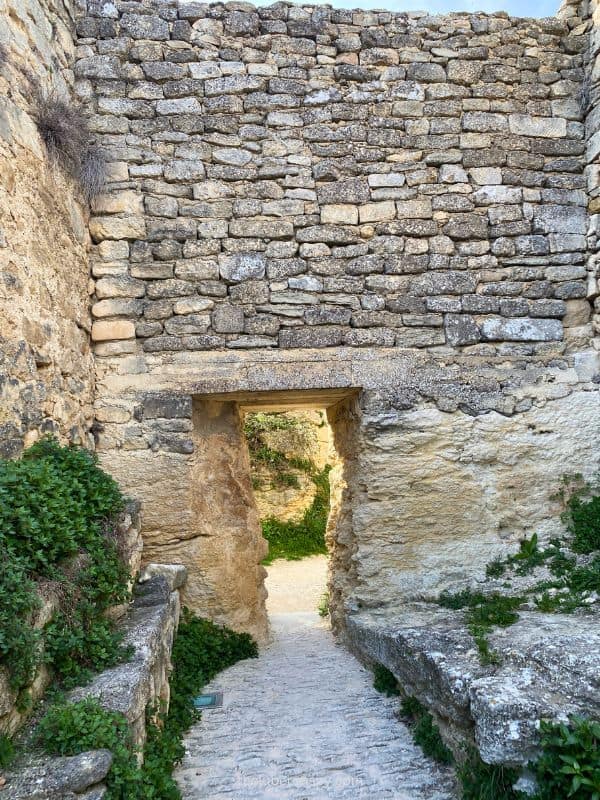
The château has been restored by various owners over decades. For me, a stroll through the castle grounds and cobbled lanes are enough.
The castle is private but open to the public in the summer months. As of this writing, it costs 12€ to enter. If you look at Google reviews, many tourists feel it’s pricey for what you see inside. (My opinion? Not worth it to go in.
There are more interesting things outdoors:
- Views of Mont Ventoux, Monts de Vaucluse, the Calavon Valley below, the town of Apt
- Belfry and wall ruins
- Three sculptures commissioned by the late Pierre Cardin. One of them is called “The Divine Marquis” which evokes the genius of writing “put in a cage.” The Marquis spent many years in French jails condemned for disturbing acts against young people.
Suggested duration of visit: 1 hour
6. MÉRINDOL: Vieux Château de Mérindol
Memories of the 16th Century Massacre
(sounds like meh-run-dol)
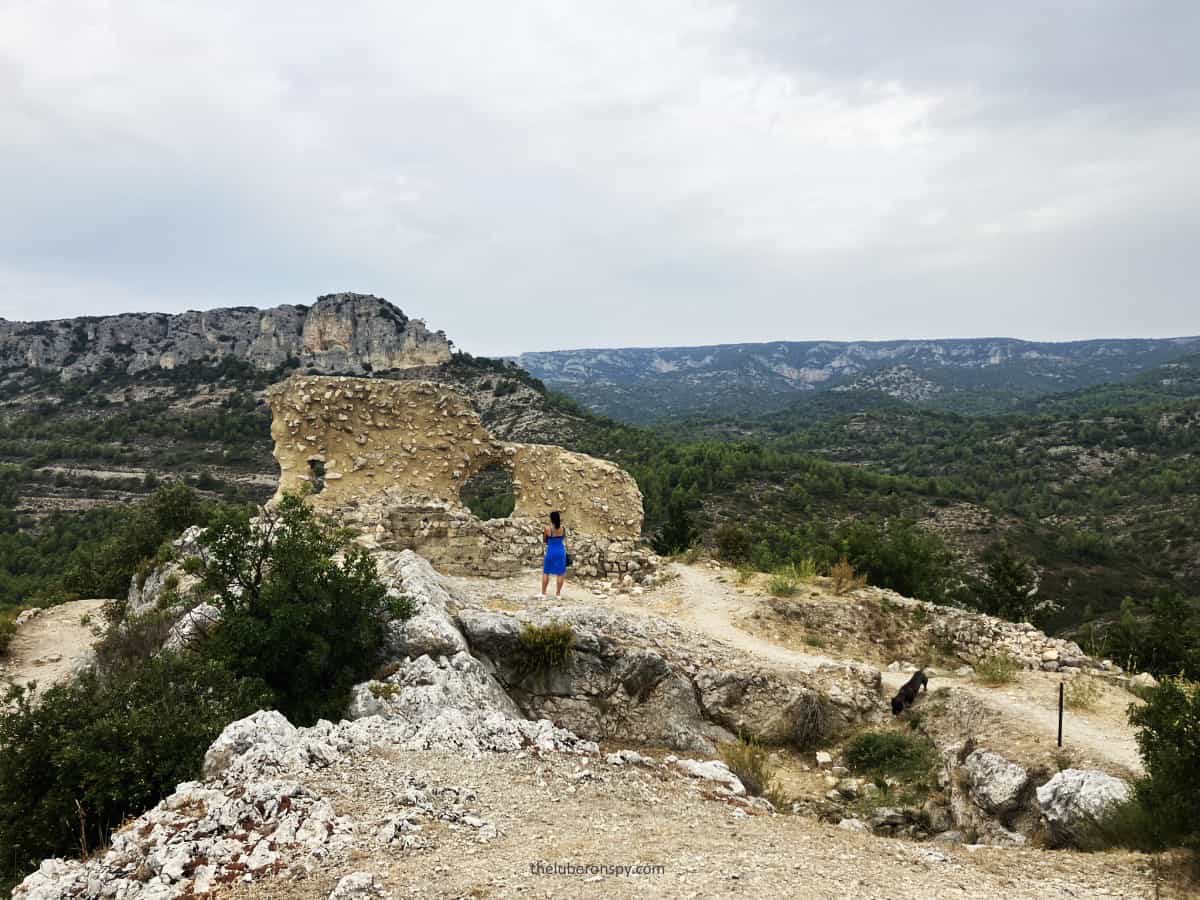
Mérindol carries a haunting history, marked by the 16th-century “hunt for heretics” during the religious wars.
King Francis I, with prodding from the Baron of Oppède, ordered the 1545 Massacre that hunted down Waldesians (or Vaudois), a Protestant group. This led to 3,000 deaths in Mérindol and neighboring Luberon villages.
The old castle and its chapel ruins now stand as a memorial to the Vaudois.
There’s this simple, yet powerful stone near the lookout point with the inscription: En memoire des Vaudois de Provence morts pour leur foi. 1545.
IN MEMORY OF THE VAUDOIS OF PROVENCE DEAD FOR THEIR FAITH. 1545.
Today, there’s La Muse, a small museum dedicated to Vaudois history. It is located right before the climb.
Though exhibits are in French, the old maps, books, photos, and items are intriguing. Operated by the Association for Waldensian and Historical Studies of the Luberon, it’s open only on Saturdays in summer.

How to Visit the Vaudois Memorial
The ruins are only accessible by foot. It’s an easy walk on a path that’s lined with trees, plants, and pretty stone houses.
Start your walk from Chemin de la Muse. There, you’ll find Parking de la Muse, with space for about 15 cars.
If you have time and would like to walk through new Mérindol, there’s a bigger parking lot beside the post office. From there, it’s about a 10-minute walk to the museum.
The Vaudois museum (La Muse), once a sheepfold, interestingly sits between old and new Merindol. For a comfortable climb, wear sturdy shoes like sneakers.
Museum hours: Saturdays only, 9:30 am-12 noon in summer months. Closed in November – March. Free entry.
From the museum, turn left and follow the signs that will lead you to the memorial. Along the path, French panels narrate the Vaudois of the Luberon massacre, guiding you to the Memorial.
Suggested duration of visit: 1-1.5 hours

Tip: To translate French text on information panels, get data plan for your phone. Download Google Translate, open it, and select the camera icon.
Set it to translate from French to English and aim your camera at the text for real-time translation. This trick is also useful in restaurants when you don’t understand the menu.
7. OPPÈDE-LE-VIEUX: Ruines d’Oppède-le-Vieux
Ghost Village on a Hilltop
(sounds like o-ped-leuh-view)
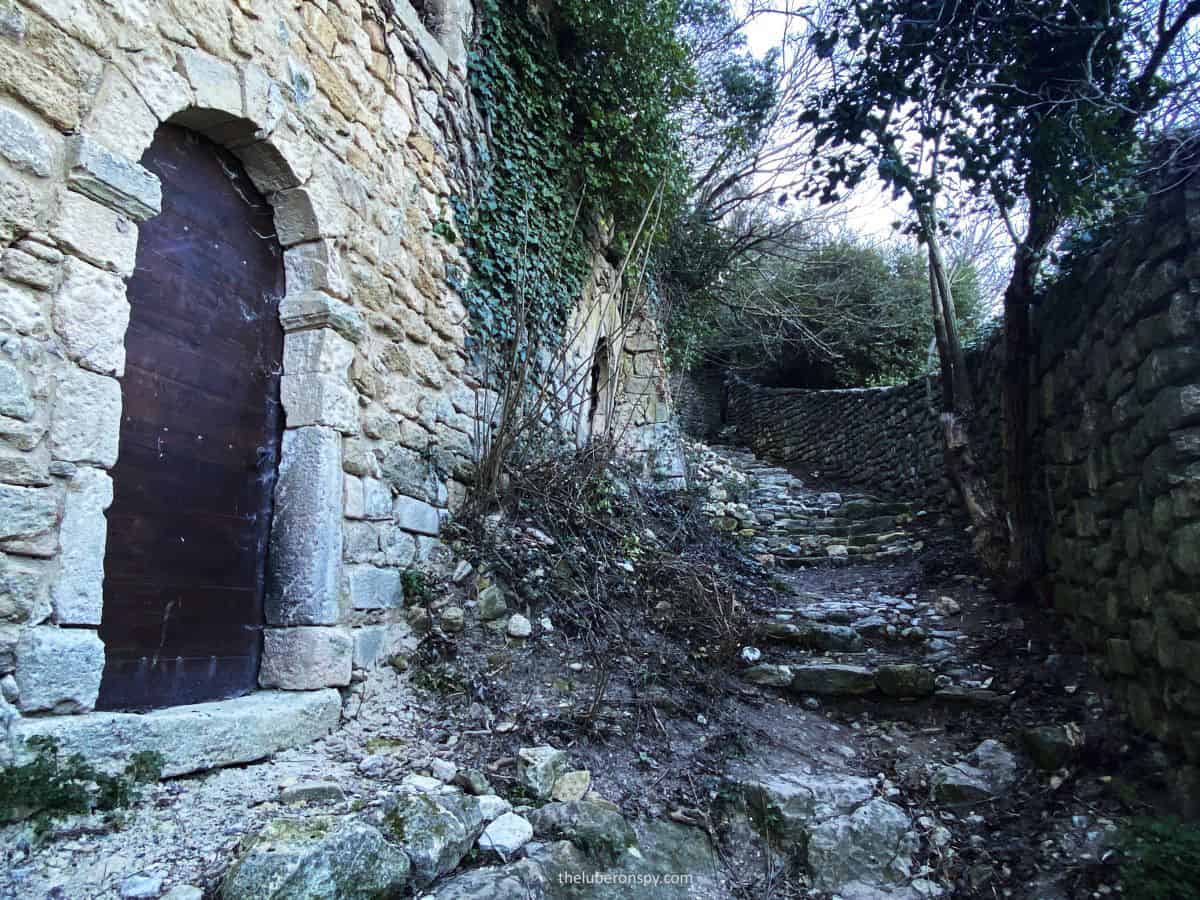
Beautiful and eerie are how I’d describe Oppède-le-Vieux (Old Oppède). I have visited this place across four seasons, and winter is my favorite.
Perched on a rocky hill, this once-thriving medieval town was abandoned after World War II when residents moved to the more food-accessible valley below (present-day Les Poulivets).
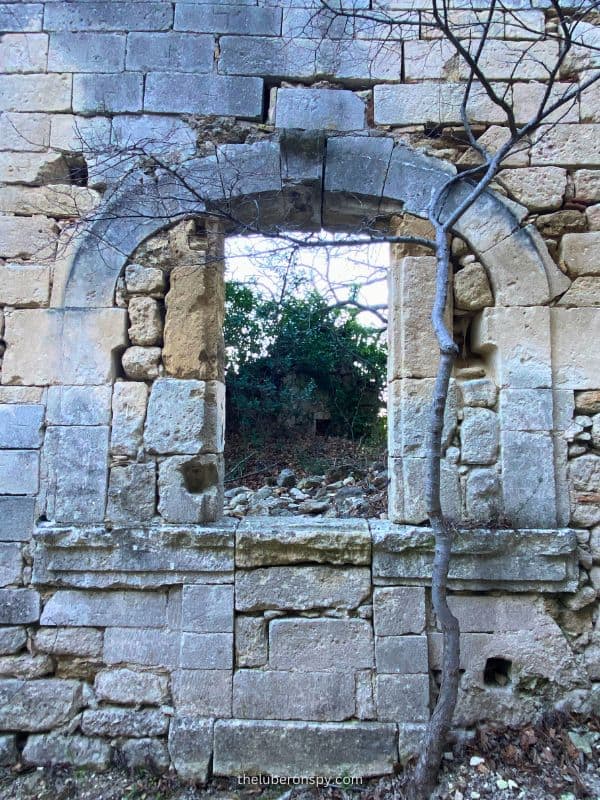
Semi-abandoned, the hilltop village of Oppède-le-Vieux is a beautiful mix of nature, mystery, and history. It is only accessible by foot.
I say “semi-abandoned” because if you look closely, a few (renovated) homes have people living in them. I imagine it would be unsafe to sell property in a crumbling village. Maybe those people are descendants of old villagers?
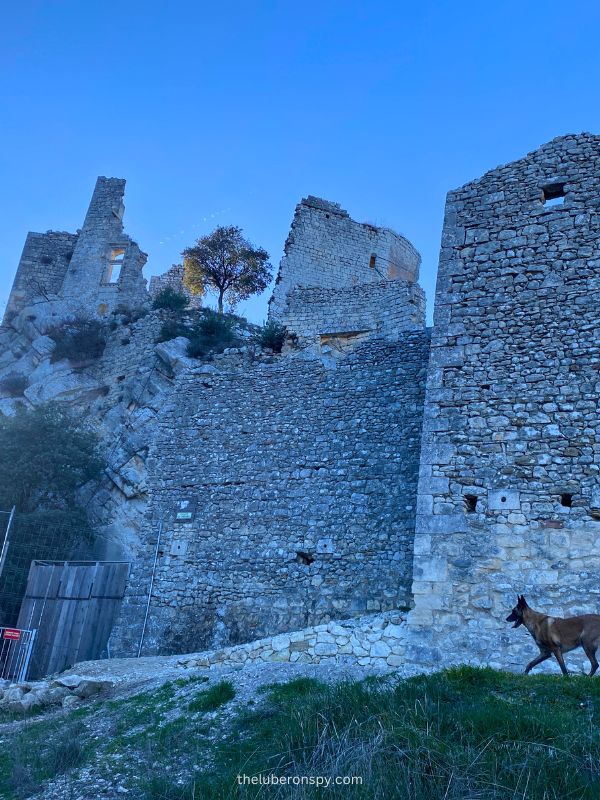
As you wander the rocky streets to the top, you’re greeted by the spectacular Notre-Dame d’Alidon Church and the castle ruins. Dating back to the 13th century, the castle, now in shambles, still showcases walls, arches, and vaulted rooms, teasing you to imagine what it would’ve looked like in old times.
The castle was home to Jean Maynier (1495 – 1558), the Baron of Oppède and the First President of the Parliament of Aix-en-Provence. He was the one responsible for the 1545 Massacre of the Vaudois.
At the top, you can enjoy nice views of the Vaucluse mountains and Mont Ventoux, particularly striking under blue skies in any season.

For me, the most fascinating part of Oppède-le-Vieux is the SATOR square (or the Templar Magic Square / Carré Magique).
Fun fact: A SATOR square is an ancient word square containing a five-word Latin palindrome.
It reads “SATOR (plower or sower) – AREPO (plow) – TENET (hold) – OPERA (work) – ROTAS (wheel)” in a square grid, that reads the same forwards, backwards, up, and down. Try to form a sentence and find meaning.
The square inspired Christopher Nolan’s 2020 sci-fi film, Tenet.
No one knows for sure what it means, though religious, symbolic, and magical hypotheses abound (weirdest one was it cured rabies).
The square had popped up across Roman-era sites across Europe, North Africa, and Asia Minor, with the earliest square found in Pompeii. How lucky are we to have one right here in the Luberon?

Interesting sites
- Church Notre Dame d’Alidon – fully restored, thanks to French comedian, actor, and singer Michel Leeb. Dubbed the church’s ‘godfather,’ Leeb led the restoration (and financing) efforts since the 2000s with support from artist friends.
He also established the Oppède Festival, a three-night annual event in August, featuring concerts and shows in the church and its grounds.
Opening hours: 1st April to 30th November, 1pm to 5:30pm on weekdays; weekends and public holidays 10am to 6pm - Chapel of the White Penitents – private and can’t be visited. But you can admire its pretty door and take photos.
- Castle ruins – Crumbling and for safety reasons, it’s barricaded and not open to the public. You can still marvel at the outside and peek through the grills.
How to Visit the Ruins of Oppède-le-Vieux
- Parking and access: Leave your car at the foot of the village. The parking lot is called Parking Saint-Cécile (€3 for 2 hours). You will walk through the old Sainte-Cécile terraces, featuring over 80 species of plants native to the Luberon. Pop by the cemetery to see some interesting tombstones.
- Be respectful: When you see lived-in homes, admire them from a distance. Avoid taking photos at their doorstep.
- Suggested duration of visit: 2 hours, which already includes the walk from the parking area. There are no explanatory panels on all the ruins, so let your imagination guide you. Summer visits can be crowded and hot, so plan accordingly.
8. SAIGNON: Le Rocher de Bellevue
The Beautiful Lookout Point that Guarded Apt
(sounds like sen-yong)
Saignon is often a detour for many tourists – the nice surprise that becomes a highlight of the trip.
If you’re looking for a small hilltop village that has a beautiful square, colorful houses, and a pretty fountain, this is one of them.
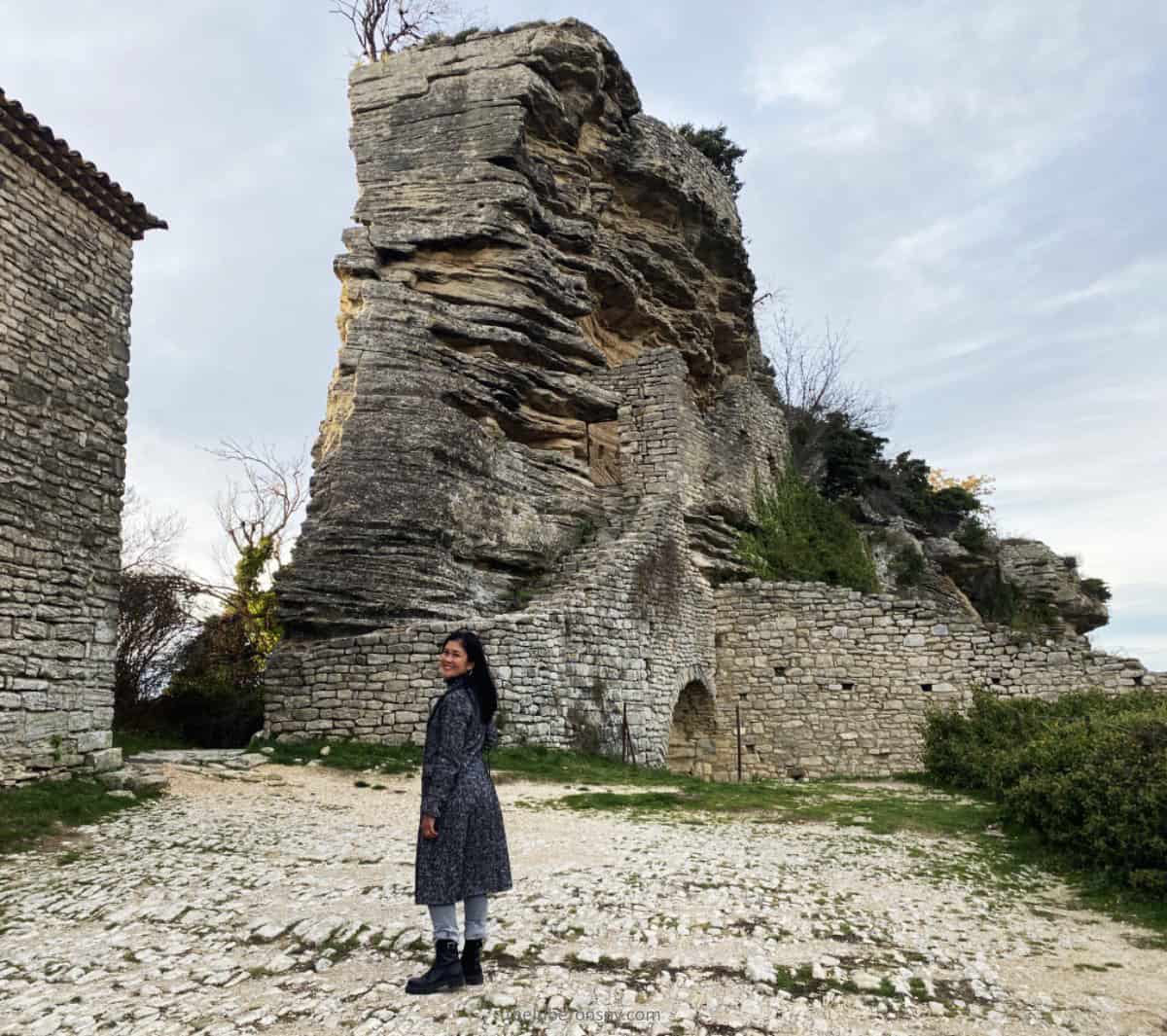
But the superstar of the village is its Rocher de Bellevue (literally means “rock of beautiful view”). Saignon (from Latin signum = sign) used to be a defensive lookout point for Apt. As you get 360-degree views from up there, it’s easy to understand why.
Bellevue Rock, resembles a monumental castle from afar. Towering at 35 meters, this rock formation not only houses an old stronghold but also offers a panoramic view of the Calavon valley and Mont Ventoux.
When cherry trees and lavender fields are in bloom in the Plateau de Claparèdes, you can see them nicely from above.
The municipality has placed a warning sign, waiving responsibility in case of accidents.
Compared to Fort de Buoux that I mentioned earlier, the rock of Saignon is a baby climb. But just the same, it is NOT for children, the physically challenged, and those with vertigo.

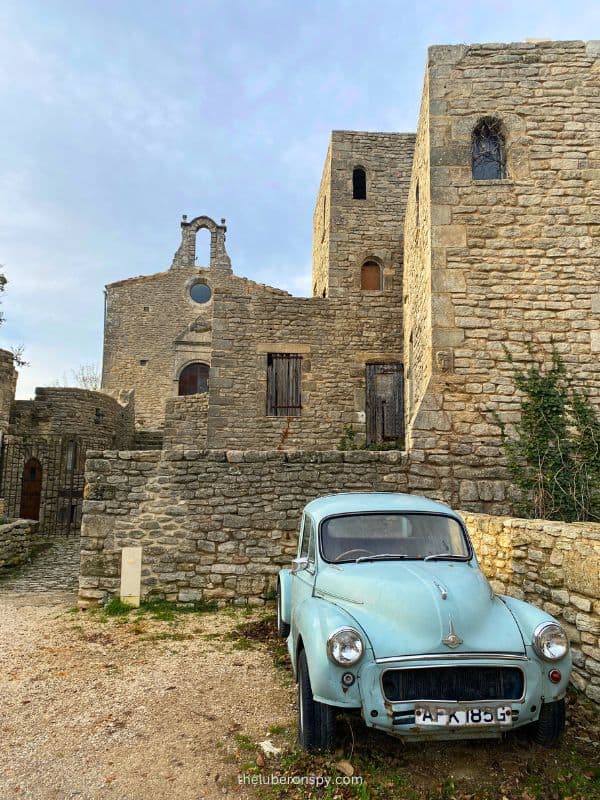
Fun fact: On your way to the viewpoint, you will see a classic, old blue car parked outside a 12th century chapel. It is a private property and a popular Airbnb with a beautifully restored modern rustic design and an rooftop pool.
How to Visit Saignon’s Bellevue Rock
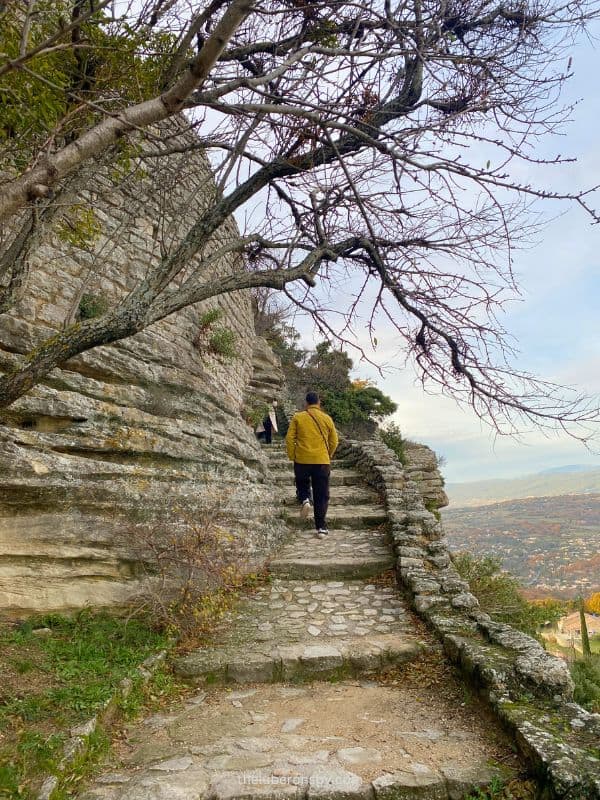
- Getting there: We usually park across the village cemetery on Rue de l’Hôpital. If it’s full, search on Google Maps “Saignon Carpark for public – closest to Saignon township,” a bigger parking lot that’s a 3-minute walk from the first.
A 10-minute walk through the village leads to the lookout point. Follow the signs. - Safety first: While the rock is accessible, exercise caution, especially with children. There are no guardrails, so keep a safe distance from the edge. In case of strong winds, avoid going to the viewpoint.
- Suggested duration of visit: 1-1.5 hours, including the village walk
9. SAINT-SATURNIN-LÈS-APT: Ruines du Château
The Miracle Site with a Dam
(sounds like sant-sa-toor-nah-les-apt)
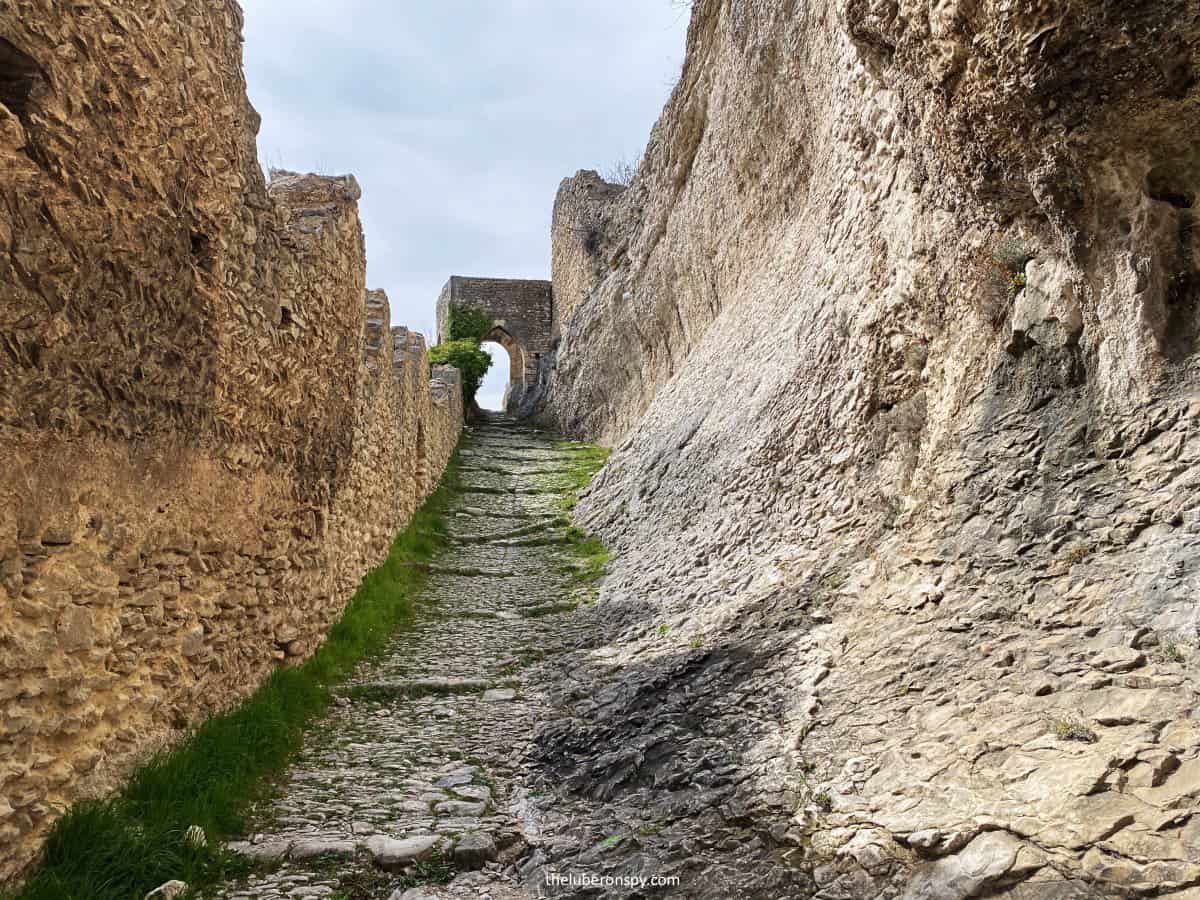
Saint-Saturnin-lès-Apt (or Saint-Sat to locals) is best known for its truffles, cherries, doors, and ruins.
The site features remnants of walls and gates, as well as the 15th-century Aiguier portal.
There’s also castle chapel (Chapelle Castrale) from 1056, which was the site of the ‘miracle of Saint-Saturnin’ that drew national attention.
Fun fact: In 1851, Rosette Tamisier claimed a chapel painting of the crucifixion bled, leaving blood-stained handkerchiefs as evidence. She was jailed for fraud, but she maintained her innocence.
This predates the famous miracle of the Virgin Mary in Lourdes (1858). The controversial painting is now kept in the commune’s storage. (I have yet to meet someone who has seen it. Ooh, the mystery!)
Chapelle Castrale only open from 13 July 2025 au 31 August 2025
Open on Tuesdays (9:30am-12:30pm), Saturdays (16h-19h), and Sundays (9:30am-12:30pm, 16h-19h).
Must contact the town hall for guided tours: +33 4 90 75 43 12. It costs 5€/person. Free access on Sundays. Check here for updates.
You’ll be surprised to discover a “small lake” suspended above the village (on Google Maps, it looks like a lake). Constructed in 1902, the dam replaced an earlier version from 1835. It supplied water to the villagers, and held about 2,200 cubic meters of water.
Depending on when you visit, the dam may either be filled with water or all dried out. I once visited in March, and there was no water.
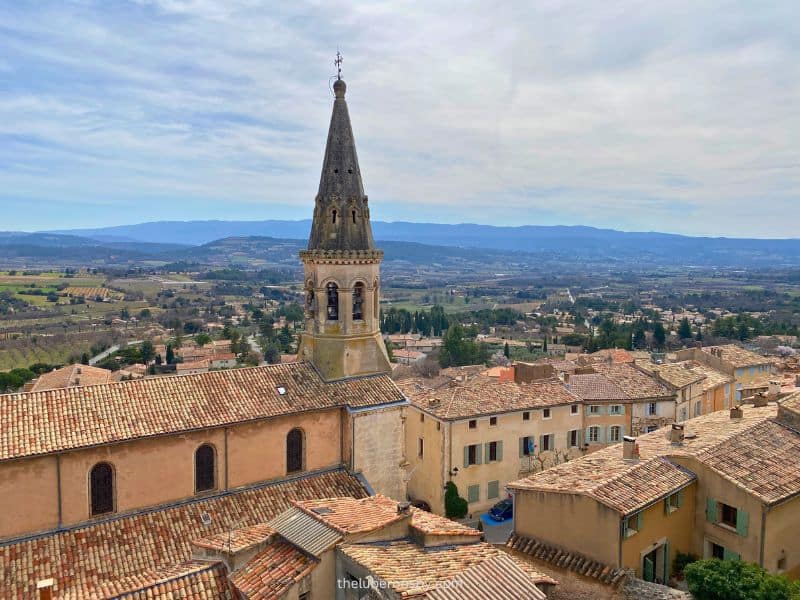
The village boasts panoramic views across the Luberon, Alpilles, and Monts de Vaucluse, surrounded by cherry orchards, olive trees, and vineyards.
In my opinion, the ruins here are not as impressive as the ones in Oppède-le-Vieux or Lacoste, but it’s still worth visiting. The views are great up there.
How to Visit the Ruins of Saint-Saturnin-lès-Apt
I was under the impression it was hard to find a parking spot here because: a) I usually got off the car first while my husband looked (in vain) for parking, and 2) the parking spaces are not marked on Google Maps.
It took us a few visits to learn there are 8 parking lots, but these are the nearest to the center:
- Place Gambetta (across SPAR supermarket and the square with the statue of Joseph Talon, the creator of truffle farming)
- Rue Jehan Rippert (across the bus stop: Avenue Jean Geoffroy)
Take note of the beautiful doors and ornately carved doorways along rue de la République. These are labeled Historique Monuments of France.
Suggested duration of visit: 1.5 hours, including the village walk
Final Thoughts: Viewpoints from Ruins of the Luberon
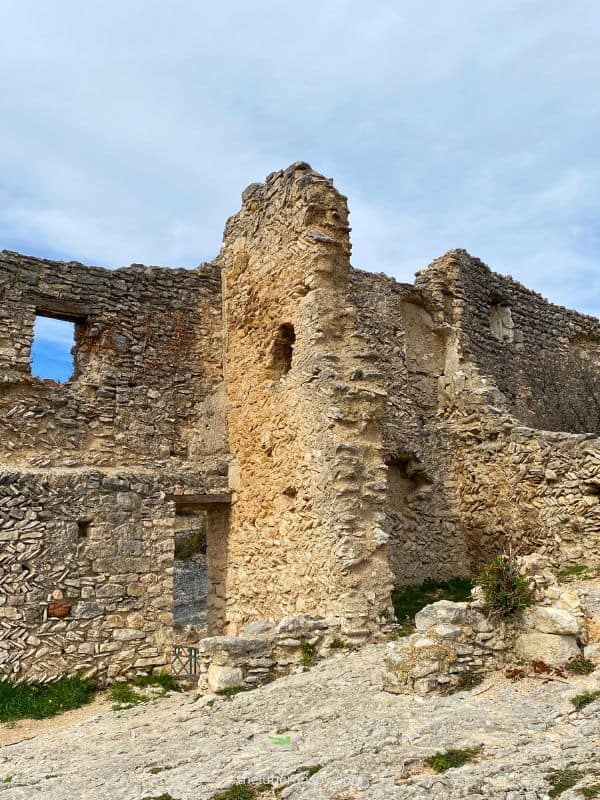
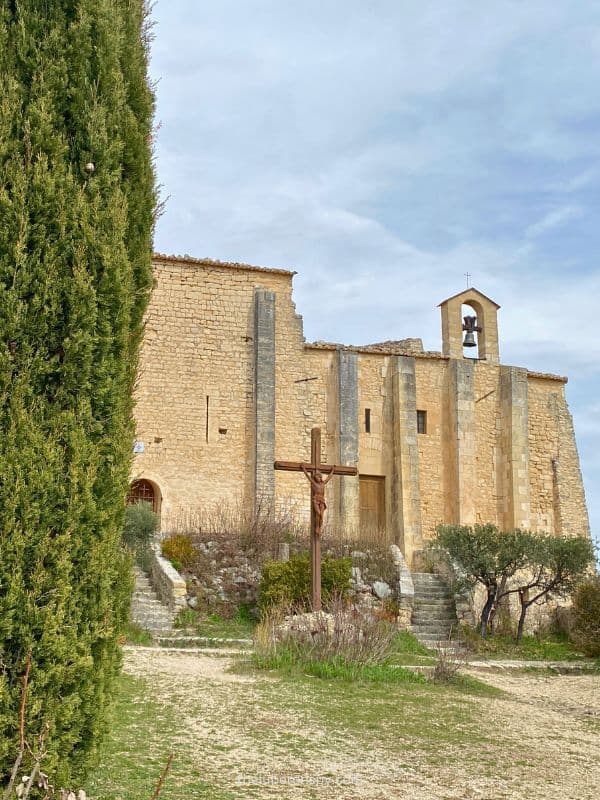
There you have it – my top picks for Luberon ruins with amazing views, open all year, even in winter.
Remember, entry to all sites is free except for Fort de Buoux (only 6 euros). You can easily reach them on foot, no hiking gear needed.
Final reminders before we end:
- Be careful in bad weather. High winds and slippery conditions are no joke.
- Take extra caution near the Buoux and Saignon cliffs – there are no guard rails.
- The ruins of Buoux are NOT for young children, the pregnant and elderly, and anyone with mobility issues or vertigo.
- Wear comfortable shoes, such as sneakers.
- Dogs are allowed in historical sites, but keep them on a leash and do not litter.
If I had to play favorites, my top three ruins would be Buoux, Oppède-le-Vieux, and Mérindol. What’s yours?
Read more:
😍 If you liked this article about ruins and viewpoints, I have a feeling you will like reading about which Luberon villages could match your interests and curiosities. It will help you, especially if you can’t decide which villages to visit.